 EN
ENPages

1920-05-32-page06
This page is not corrected, please help correct this page
1920-05-32-page07
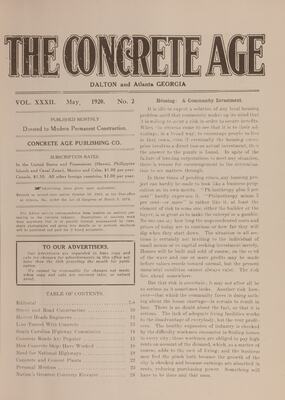
THE CONCRETE AGE
DALTON and Atlanta GEORGIA
VOL. XXXII. May, 1920. No. 2
PUBLISHED MONTHLY
Devoted to Modern Permanent Construction.
CONCRETE AGE PUBLISHING CO.
SUBSCRIPTION RATES.
In the United States and Possessions (Hawaii, Phillippine Islands and Canal Zone), Mexico and Cuba, $l.OO per year. Canada, $1.50. All other foreign countries, $2.00 per year.
Advertising rates given upon application. Entered as second-class matter October 18, 1905, at the Post-office at Atlanta, Ga., under the Act of Congress of March 3, 1879.
The Editor solicits correspondence from readers on matters pertaining to the concrete industry. Descriptions of concrete work done anywhere that is of general interest accompanied by clear, sharp photographs and going into details as to methods employed will be published and paid for if found acceptable.
TO OUR ADVERTISERS.
Our advertisers are requested to have copy and cuts for changes for advertisements in this office not later than the 10th preceding the month for publication.
We cannot be responsible for changes not made, when copy and cuts are received later, or submit proof.
TABLE OF CONTENTS.
Editorial 7-8
Street and Road Construction 10
Hoover Heads Engineers 12
Line Tunnel With Concrete 13
South Carolina Highway Commission 14
Concrete Roads Are Popular 15
How Concrete Ships Have Worked 18
Need for National Highways 19
Concrete and Cement Plants 22
Personal Mention 23
Nation’s Greatest Concrete Elevator . 24
Housing: A Community Investment.
It is idle to expect a solution of any local housing problem until that community makes up its mind that it is willing to incur a risk in order to secure benefits. When the citizens come to see that it is to their advantage, in a broad way, to encourage people to live in that town, even if eventually the housing enterprise involves a direct loss on actual investment, then the answer to the puzzle is found. In spite of the failure of housing corporations to meet any situation, there is reason for encouragement in the determination to see matters through.
In these times of pending crises, any housing project can hardly be made to look like a business proposition on its own merits. “Philanthropy plus 5 per cent’’ hardly expresses it. “Philanthropy minus 5 per cent —or more” is rather like it, at least the element of risk to some one, either the builder or the buyer, is so great as to make the enterprise a gamble. No one can say how long the unprecedented costs and prices of today are to continue or how far they will dip when they start down. The situation in all sections is certainly not inviting to the individual of small means or to capital seeking investment merely. Houses will be built and sold of course, on the crest of the wave and one or more profits may be made before values recede toward normal, but the present unnatural condition cannot always exist. The risk lies ahead somewhere.
But that risk is uncertain; it may not after all be so serious as it sometimes looks. Another risk however—that which the community faces indoing nothing about the house shortage—is certain to result in loss. There is no doubt about the fact, or that it is serious. The lack of adequate living facilities works to the disadvantage of everybody, but the rent profiteers. The healthy expansion of industry is checked by the difficulty workmen encounter in finding homes in every city; these workmen are obliged to pay high rents on account of the demand, which, as a matter of course, adds to the cost of living; and the business men feel the pinch both because the growth of the city is checked and because earnings are absorbed in rents, reducing purchasing power. Something will have to be done and that soon.
1920-05-32-page08
This page is not corrected, please help correct this page

1920-05-32-page09
This page is not corrected, please help correct this page
1920-05-32-page10
This page is not corrected, please help correct this page